
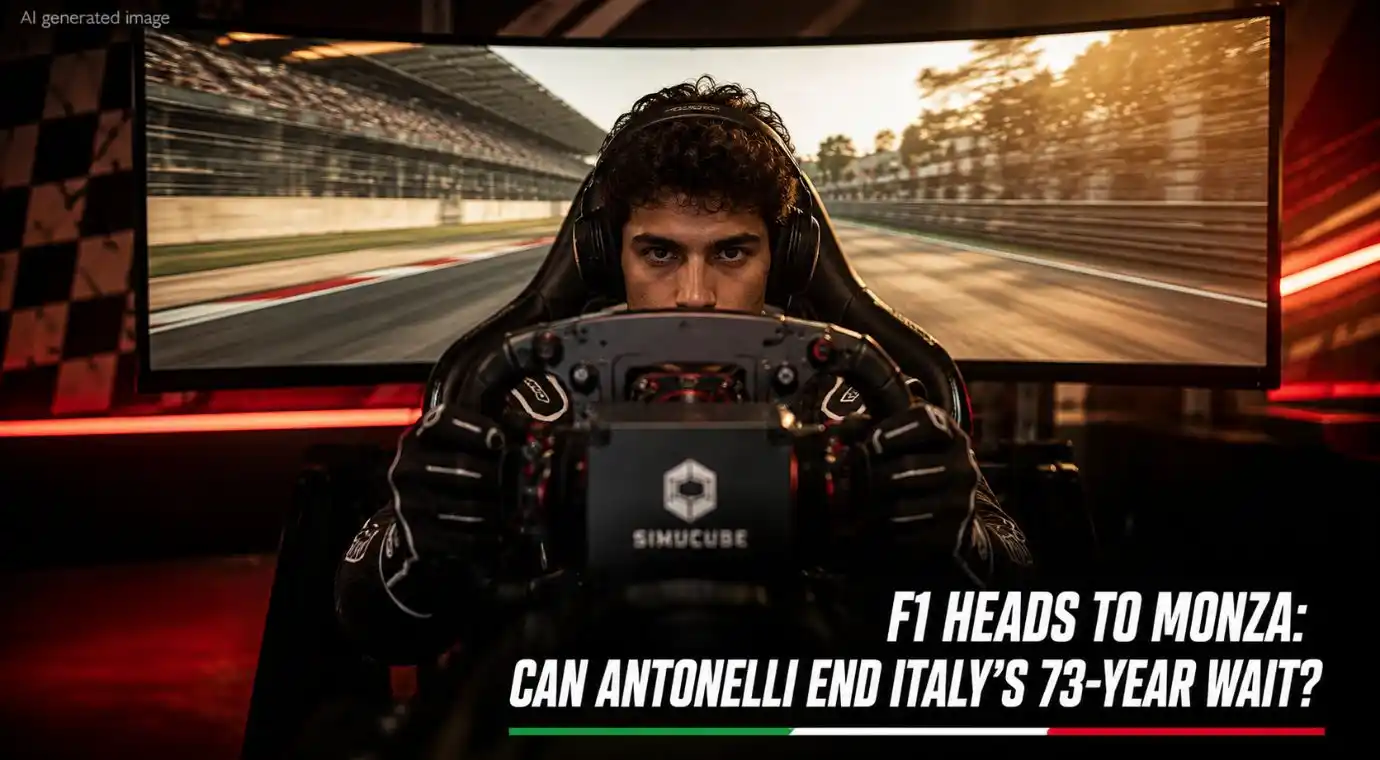
Formula 1’s calendar moves straight from Zandvoort’s emotional farewell to one of the sport’s most storied venues: Monza, home of the Italian Grand Prix, and this year carrying weight beyond the usual home-race atmosphere. Kimi Antonelli arrives at Monza holding the championship lead, chasing what would be Italy’s first drivers’ title since Alberto Ascari won it in 1953, a 73-year wait that suddenly has a very real chance of ending, at the one circuit where the pressure will be loudest.
McLaren, fresh off Norris’s back-to-back win at Zandvoort, will be looking to carry that momentum into a circuit with very different characteristics, Monza’s long straights and low-downforce demands reward outright power and slipstream tactics far more than Zandvoort’s tight, banked corners ever did. It sets up a genuinely interesting tactical shift in the title fight, on top of the emotional weight of an Italian driver chasing history in front of the most passionate home crowd in the sport.
Why Monza Tests a Completely Different Skill Set
If Zandvoort was about precision through banked, technical corners, Monza is almost the opposite challenge. Nicknamed “the Temple of Speed,” it’s built around long straights, minimal aerodynamic drag setups, and late, heavy braking zones into tight chicanes — a circuit where a fraction of a second gained on the straight through a good slipstream can matter as much as a clean lap through the corners.
This shift matters for anyone watching closely, because it changes what “good driving” looks like race to race. A driver who thrived on Zandvoort’s banking needs a different mentality entirely at Monza, trail braking late into a chicane after 340 km/h of straight-line speed, managing slipstream tactics in traffic, and getting the low-downforce balance right for a track that punishes both too much and too little wing.
What Racing at Home Actually Adds to the Pressure
There’s a specific, well-documented phenomenon in motorsport (and sport generally) where competing in front of a home crowd amplifies pressure rather than simply providing support. Every mistake feels louder. Every strong lap feels like it matters more. For Antonelli, an Italian driver at Monza chasing history no Italian has achieved since 1953, that pressure is about as high as it gets in the sport right now.
This is a genuinely useful thing to understand if you’ve ever wondered why “composure” gets talked about as a skill in its own right, separate from raw pace. A coached racing simulator Pune session that pushes you through pressure scenarios, a tight qualifying lap, a late-race defensive stint, starts to make this tangible. The technical skill required to drive well doesn’t change under pressure, but the ability to actually execute it cleanly while your focus is being pulled in a dozen directions is a separate, trainable thing entirely.
Slipstreaming and Late Braking: Skills You Can Actually Practice
Monza-style racing rewards two specific techniques that translate surprisingly well into a coached simulator environment:
- Slipstream positioning. Understanding how closely to follow another car to gain a straight-line speed advantage, and when to pull out for an overtake, is a skill that benefits enormously from repetition and feedback, exactly what a coached session provides.
- Late braking into a chicane. Monza’s chicanes demand extremely late, hard braking after very high speed. Getting this wrong costs significant time; getting it right consistently is one of the more satisfying, learnable precision skills in racing.
An F1 simulator experience Pune venue with accurate circuit modelling lets you actually attempt both of these rather than just watching them happen on screen — and quickly reveals how much harder consistent late braking is than it looks from the couch.
A Good Weekend to Watch – And a Good Excuse to Try It Yourself
With Antonelli’s title chase reaching this level of national and global attention, Monza weekend is shaping up to be one of the bigger watch moments of the season’s second half. If it has you curious about what late braking at 340 km/h actually demands, or what it feels like to manage a slipstream battle rather than just watch one, there’s no better excuse to finally try a coached session yourself.
Frequently Asked Questions
Why hasn’t an Italian driver won the F1 title since 1953?
It reflects how rare a combination of a competitive car and sustained peak performance from an Italian driver has been across F1’s history, Alberto Ascari remains the last Italian champion, winning in 1952 and 1953.
What makes Monza different from Zandvoort as a circuit?
Monza is a low-downforce, high-speed circuit built around long straights and late braking zones, rewarding straight-line speed and slipstream tactics, whereas Zandvoort’s banked corners rewarded cornering precision.
Can a racing simulator help me understand late braking and slipstreaming?
Yes, a coached session with accurate circuit modelling lets you practice both techniques directly, with feedback on braking points and positioning that’s hard to develop just from watching.
Does home-race pressure really affect driver performance?
It’s a well-recognised factor in motorsport and sport generally, competing in front of a home crowd tends to amplify pressure, which is part of why composure is considered a separate, trainable skill from raw speed.
Do I need to follow F1 to enjoy trying these techniques myself?
No, sessions are coached from your current level regardless of how closely you follow the sport.