
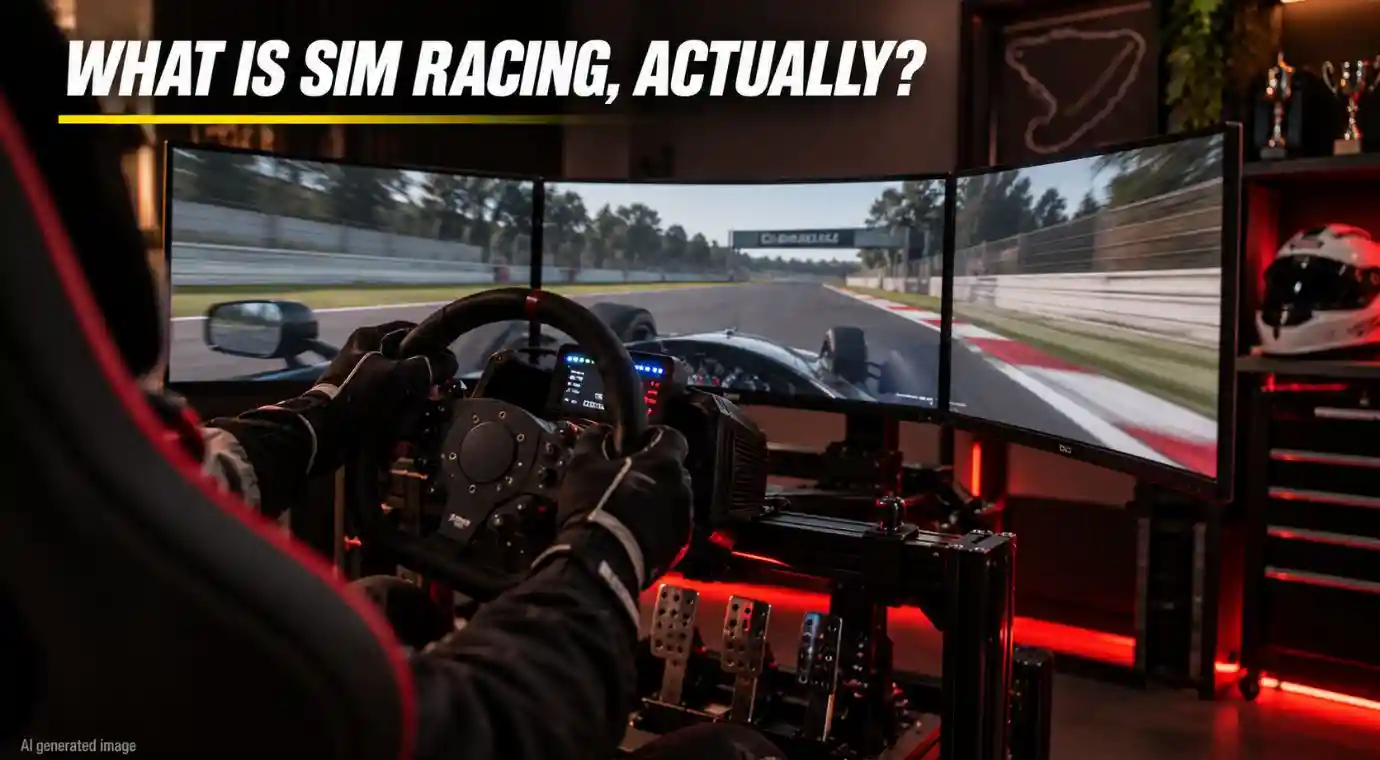
Say the words “sim racing” to someone outside the sport and you’ll usually get one of two reactions: a shrug, or a mental image of a teenager slouched on a couch with a plastic steering wheel clipped to a coffee table. Neither is close to what the term actually means once you’ve sat in a proper rig. Here’s the plain-English version, what sim racing is, what it isn’t, and why professional racers use it as real training rather than a way to pass an evening.
The short answer
Sim racing is competitive or training-focused motorsport driving done on a racing simulator, a setup that uses a real physics engine, force-feedback hardware, and (in a proper training environment) a coach, to recreate how a car actually behaves on track. It’s not a genre of video game. It’s a discipline that happens to run on software instead of asphalt, and the best simulators are taken seriously enough that actual race teams use them to prepare drivers for real events.
Why “just a video game” is the wrong comparison
The confusion is understandable, because sim racing and racing video games look similar from across the room: a screen, a wheel, someone driving a virtual car. The difference is underneath the surface, in three specific places.
The physics. A racing video game built for mass-market entertainment is tuned to be fun and forgiving, cars that slide predictably, mistakes that are easy to recover from, difficulty settings that soften the learning curve. A sim racing platform is tuned to be accurate. Tire grip, weight transfer under braking, how a car behaves the moment it steps past the limit of traction, all of it is modeled to match real physics as closely as the software allows, because the entire point is that what you learn on the sim should transfer to a real car.
The hardware. A comfortable, arcade-style controller trades feedback for ease of use. Sim racing hardware does the opposite, a direct-drive force-feedback wheel pushes back against your hands with real resistance, load-cell brake pedals respond to actual pressure rather than a simple on/off switch, and a proper cockpit positions you the way you’d actually sit in a race car. The hardware is designed to make the experience harder to master, not easier, because that difficulty is where the learning happens.
The coaching. This is the part that separates a training environment from a home setup entirely. A racing video game teaches you nothing except how to beat that specific game. A coached sim racing session teaches braking points, racing lines, throttle and brake modulation, and race craft, the same fundamentals a driving instructor would teach in a real car, just without the cost and risk of doing it on an actual track on day one.
Who actually uses this, and why it’s taken seriously
If sim racing were just entertainment, professional motorsport wouldn’t spend real money on it. It does, extensively. Formula 1 teams run simulator programs for their drivers between race weekends, using rigs that cost more than the cars some amateur racers compete in. Junior drivers coming up through karting and single-seater categories log serious hours on simulators specifically to learn new circuits before ever driving them for real, cutting down the number of real-world laps needed to get up to speed. Esports-to-real-racing pathways, programs that scout talent from competitive sim racing and put the winners into actual race cars, exist precisely because the skills genuinely do transfer.
None of that happens by accident. It happens because the physics and feedback are accurate enough that muscle memory, reaction time, and racecraft built on a simulator hold up when the stakes become real.
What a real sim racing session actually involves
Strip away the misconceptions and a genuine training session looks like this: you sit in a cockpit built to match real seating position, strap into a harness the way you would in an actual race car, and work with a coach who’s watching your braking points, your line through each corner, and how smoothly you’re transferring weight through the chassis. Sessions are usually structured, a warm-up to build feel for the car, focused work on specific corners or techniques, then longer runs to build consistency under fatigue, the same way a real track day would be structured. It’s physical in a way people don’t expect: sustained concentration, real muscular effort fighting the wheel’s resistance, and genuine heart-rate elevation during a hard session.
Who it’s actually for
The honest answer is: almost anyone, which is part of what makes it different from real motorsport. You don’t need a racing license, a car, or years of savings to start, the barrier that keeps most people out of real racing simply doesn’t exist here. Complete beginners use it to find out, safely and affordably, whether they actually enjoy the sport before committing to anything real. Existing karters and racers use it to sharpen specific skills or learn a new circuit without burning an expensive track day doing it. And increasingly, it’s simply become the way serious motorsport training starts, not a substitute for the real thing, but the genuine first rung of the same ladder.
The one-sentence version
Sim racing is real motorsport training that happens to run on accurate simulation hardware instead of a track, closer in spirit to a flight simulator used by pilots than to anything you’d call a video game.
Frequently Asked Questions
Q: Is sim racing the same as a racing video game?
No. Racing video games are built for entertainment with forgiving physics and simplified controls. Sim racing uses accurate physics modeling and professional-grade force-feedback hardware specifically so the skills learned transfer to real driving.
Q: Do real racing drivers actually use sim racing?
Yes. Formula 1 teams and junior single-seater programs use simulators to prepare drivers, learn new circuits, and build race craft between real track sessions, it’s a standard part of professional motorsport training, not a hobby activity.
Q: Do I need any prior experience to try sim racing?
No. Most people who try it for the first time have never driven a race car or even a manual-transmission road car. A coached session is built to start from wherever you are.
Q: What makes sim racing hardware different from a gaming controller?
Direct-drive force-feedback wheels, load-cell brake pedals that respond to real pressure, and a cockpit positioned like an actual race car, all designed to replicate genuine driving feel rather than simplify it.
Q: Is sim racing physically demanding?
More than people expect. A focused session involves sustained concentration, real physical effort against the wheel’s resistance, and noticeable fatigue by the end, closer to a workout than to casual gaming.
Q: Can sim racing actually prepare someone for real karting or racing?
Yes, for the fundamentals, racing lines, braking points, throttle control, and race craft transfer directly. It doesn’t replace real-world experience of managing an actual vehicle’s weight and risk, but it builds the mental and technical foundation before you ever need to.