
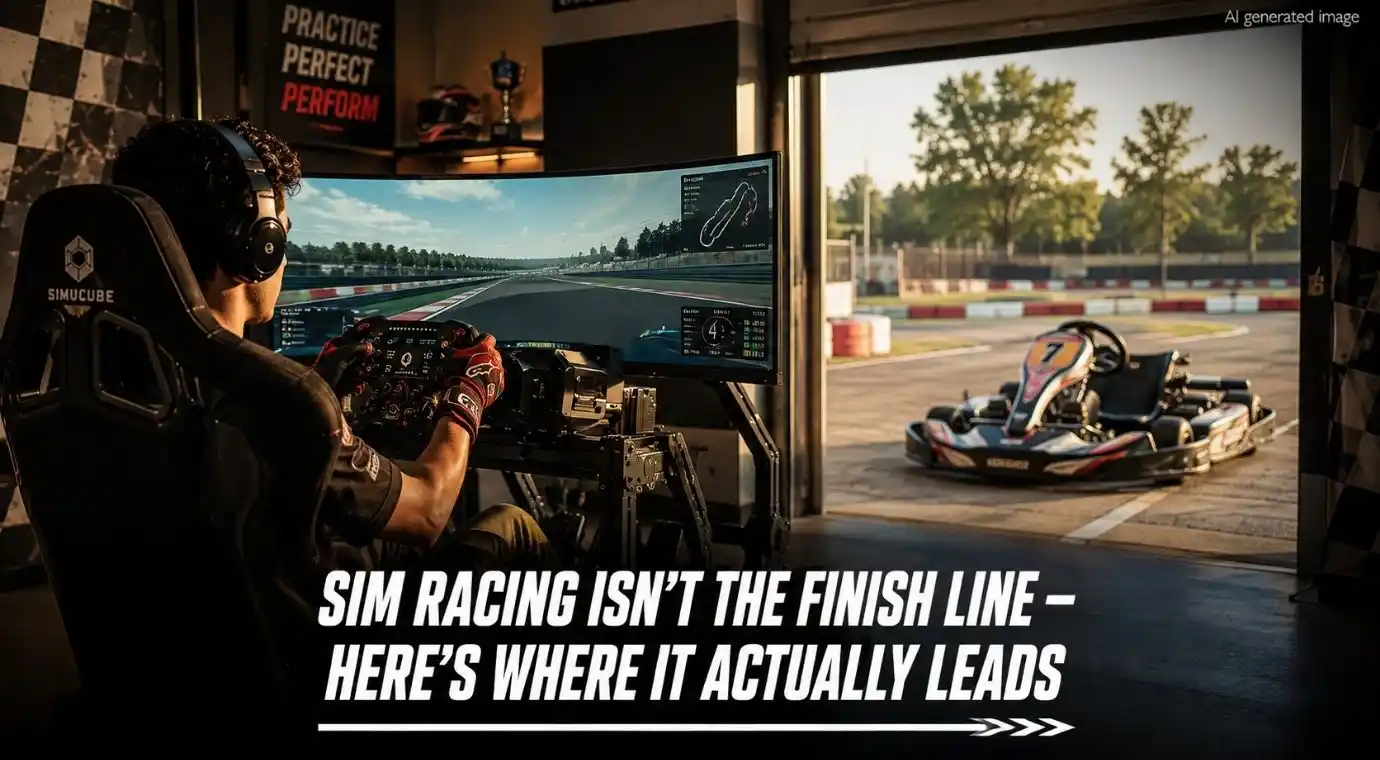
A common assumption about racing simulators is that they’re a closed loop, you train on a rig, you get better at the rig, and that’s where it ends. That’s true for arcade-style setups, but it misses what a properly built training program is actually designed to do. At SwitchBack, sim racing on a Hybrid GT simulator isn’t positioned as the destination, it’s built as the first stage of a genuine path that leads toward real karting.
This is worth unpacking properly, because “sim to real” is often used as a vague marketing phrase without much substance behind it. Here’s what actually makes that transition real, and what to expect at each stage.
Why Start on a Simulator At All, If the Goal Is Real Karting?
The honest answer is risk and repetition. Learning fundamentals, braking points, racing lines, smooth inputs, consistency — on a real kart from day one means every mistake carries real physical risk and real cost (worn tyres, potential damage, actual crashes). A simulator removes that risk entirely while preserving the core skill-building loop: you can attempt the same corner twenty times in a session, get immediate coaching feedback, and build muscle memory for correct technique before ever needing to manage real speed, real g-forces, and real consequences.
This is also why a racing simulator Pune venue built around a proper Hybrid GT simulator setup, rather than a basic arcade unit — matters so much for this specific goal. Sim-to-real training only works if the simulator itself models car behaviour, braking, and cornering physics accurately enough that what you learn actually transfers. A simulator that doesn’t reflect real vehicle dynamics teaches habits that don’t carry over, or worse, habits that need to be unlearned once you’re in a real kart.
What Actually Transfers From Sim to Kart
Not everything translates one-to-one, and being honest about this matters. What genuinely carries over:
- Racing lines and braking points. The fundamental geometry of a fast line through a corner, and where to brake for it, transfers well, since these are fixed principles regardless of what you’re driving.
- Smoothness and input discipline. Learning to avoid jerky, over-corrected inputs on a simulator builds a habit that matters just as much, if not more, in a real kart.
- Situational awareness and reaction time. Reading traffic, reacting to another vehicle’s unexpected move, and general hazard awareness built through simulator repetition carries over directly.
- Confidence with the basic mechanics of racing. First-time real kart drivers who’ve never driven anything competitively often spend their first sessions just getting comfortable with the idea of pushing a vehicle near its limits. Sim training removes a lot of that initial hesitation.
What doesn’t fully transfer, and shouldn’t be oversold:
- Real g-forces and physical sensation. No simulator, however good, replicates the actual physical feeling of cornering forces, vibration, and real speed.
- Real risk perception. Knowing a mistake in a simulator costs a lap time rather than actual safety changes decision-making in ways a simulator can’t fully replicate.
What a Realistic Progression Actually Looks Like
For someone starting from zero, a sensible progression through sim training toward real karting generally follows a pattern like this:
- Foundational coached sessions: building comfort with the wheel, pedals, and basic car control, with a coach correcting habits from the very first lap.
- Consistency-focused training: moving from “can complete a lap” to “can complete several clean, consistent laps in a row,” which is the real marker of readiness to progress.
- Precision refinement: braking points, racing lines, and reaction to changing conditions get more detailed coaching focus once the basics are solid.
- Transition toward real karting: for those pursuing it, simulator training at this stage becomes preparation and reinforcement alongside real track time, rather than a replacement for it.
Who This Path Actually Suits
This progression isn’t only for people with competitive racing ambitions. It suits:
- Complete beginners who want a genuinely structured, low-risk way to build real driving fundamentals before ever getting near a real kart.
- Existing kart drivers who want simulator time to refine specific technique (braking points, a tricky corner) without burning real track time and tyres doing it.
- Motorsport enthusiasts who are curious about the sim-to-real pathway even if real karting isn’t an immediate goal, simply because the coached fundamentals are valuable on their own.
Why This Distinction Matters When Choosing a Venue
Not every F1 simulator experience Pune offers actually connects to anything beyond the simulator itself. If a genuine progression toward real karting matters to you, it’s worth specifically asking any venue whether their simulator training is designed with that transition in mind, accurate physics, structured coaching progression, and an actual pathway — rather than assuming any simulator experience automatically prepares you for real karting.
Frequently Asked Questions
Does sim racing actually prepare you for real karting?
Yes, for specific fundamentals, racing lines, braking points, smoothness, and situational awareness transfer well, though real g-forces and risk perception can’t be fully replicated by any simulator.
Do I need real karting experience to start sim training?
No. Sim training is designed to work from zero experience, building fundamentals before any real karting is involved.
Is a Hybrid GT simulator different from a standard racing simulator?
Accurate physics modelling matters significantly for sim-to-real transfer, a simulator needs to reflect real vehicle dynamics closely for the skills learned to genuinely carry over to real karting.
Can experienced kart drivers benefit from simulator training too?
Yes, simulator sessions let experienced drivers refine specific technique without the cost and wear of real track time.
How long does it typically take to progress from sim training toward real karting readiness?
This varies by individual pace and prior experience; a coach can give a realistic assessment based on progress across sessions rather than a fixed timeline.