
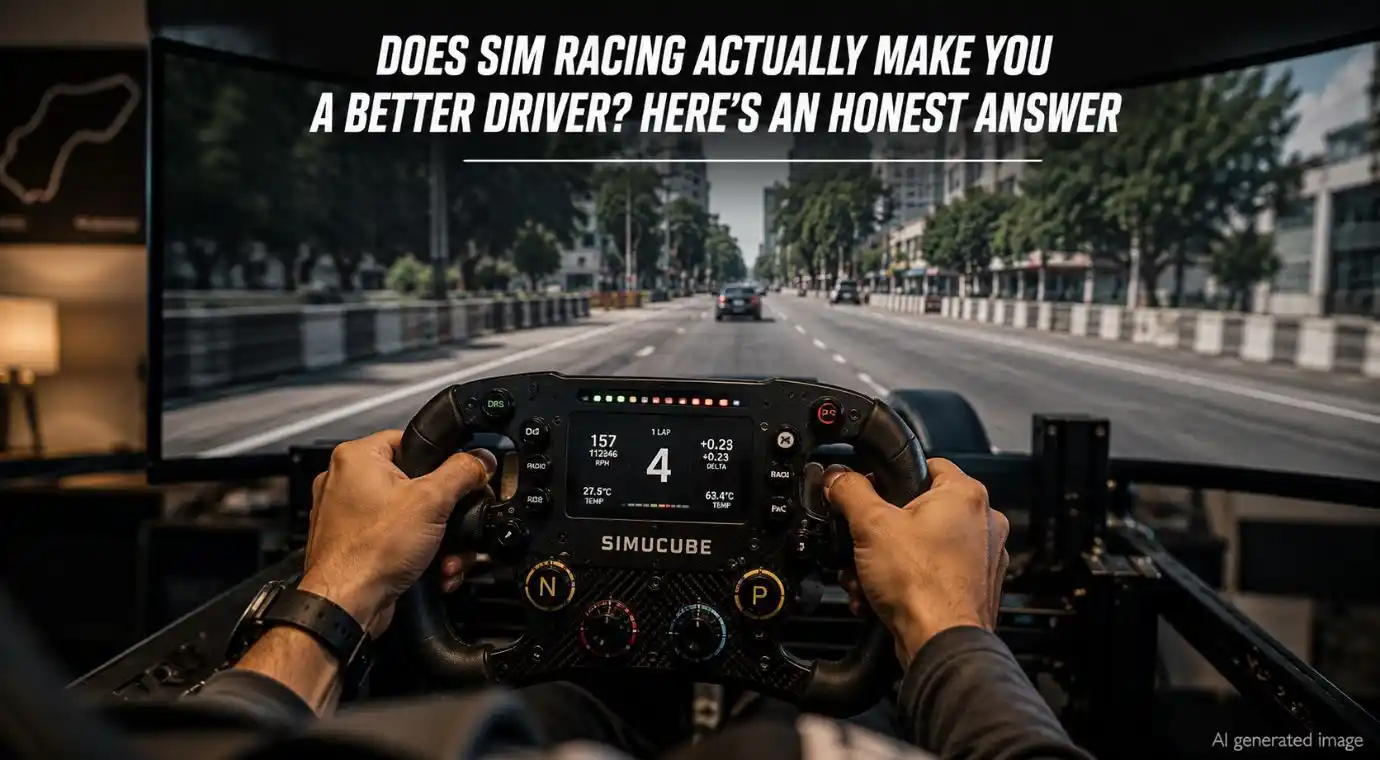
It’s a fair question, and one worth answering honestly rather than with a marketing-friendly “absolutely, 100%.” Racing simulators are genuinely good at building certain driving-relevant skills, and genuinely limited in others. Understanding the difference matters, whether you’re curious for yourself, considering it for a teenager who’s about to start driving, or just tired of vague claims that never get specific.
What Sim Racing Genuinely Builds
Reaction time and hazard awareness. Coached sessions repeatedly put you in situations that demand quick, correct decisions — when to brake, when a gap is closing too fast, how to react when a car ahead does something unexpected. This kind of repeated, low-stakes exposure genuinely sharpens reaction speed and situational awareness in ways that transfer to real-world alertness behind the wheel.
Spatial awareness and vehicle placement. Understanding exactly where your car’s edges are relative to a track boundary, another vehicle, or a corner apex is a skill that builds with repetition, and it’s directly relevant to real-world driving, particularly tight parking, lane positioning, and judging gaps in traffic.
Smoothness and control discipline. One of the first things coaches correct in a simulator is jerky, over-corrected steering and abrupt braking. Learning to be smooth, gradual inputs, controlled weight transfer, is one of the most transferable skills from sim racing to real driving, and it’s also one of the clearest markers of a genuinely good driver versus a merely confident one.
Confidence under time pressure. Real driving occasionally throws split-second decisions at you, a car merging unexpectedly, a pedestrian stepping out, a sudden need to brake hard. Repeated exposure to high-pressure, fast-decision scenarios in a coached simulator setting builds a calmer baseline response to those moments, rather than panic.
What Sim Racing Can’t Replace
Honesty matters here, because overselling this undermines trust. A racing simulator, even an excellent, professionally coached one, cannot fully replicate:
- Real physical consequences and risk perception. Knowing a mistake in a simulator costs you a lap time, not your safety, changes the psychology of decision-making in ways no amount of realism fully closes.
- Real-world unpredictability. Pedestrians, potholes, unpredictable other drivers, weather changing mid-drive, and dozens of other real-road variables aren’t something any simulator fully captures.
- Actual vehicle dynamics under every condition. A simulator models a specific car on a specific track well, but it isn’t a substitute for time behind the wheel of your actual daily vehicle, learning how it specifically handles.
- Legal driving knowledge. Traffic rules, right-of-way situations, and road sign literacy are things a simulator session simply doesn’t teach.
The honest positioning is this: sim racing is an excellent way to build core reflexes, control discipline, and awareness — a genuinely useful supplement, particularly for people who want a structured, coached way to sharpen these fundamentals. It is not, and shouldn’t be marketed as, a replacement for a real driving license course or road experience.
Where the Two Actually Overlap Best
For new and nervous drivers specifically, a coached racing simulator Pune session can be a genuinely low-stakes way to build baseline comfort with hazard reaction and vehicle control before or alongside real-world driving practice — removing some of the anxiety that comes with learning both “how to react” and “what happens if I get this wrong” at the same time on an actual road.
For experienced drivers and motorsport enthusiasts, the value shifts, it’s less about building basic road safety and more about refining precision: braking points, racing lines, and the kind of fine control that a normal commute never demands. This is where an F1 simulator experience Pune venue earns its “training” positioning rather than “arcade” positioning, coached sessions push toward genuine skill refinement, not just entertainment.
What a Coached Session Actually Focuses On
To be specific rather than vague about this, here’s what a properly coached sim racing session typically works on, broken down by the skill it targets:
- Braking discipline: consistent, repeatable braking points rather than late, panicked stops.
- Smooth steering inputs: gradual, controlled corrections instead of jerky over-steering.
- Situational scanning: actively reading what’s ahead rather than fixating narrowly.
- Composure after a mistake: resetting focus quickly rather than compounding one error into several.
- Consistency over single bursts of speed: the same discipline that separates a good driver from a merely fast one.
Every one of these has a real-world driving parallel, which is precisely why coached sessions are structured around them rather than just “drive fast and have fun.”
A Skill-Building Activity That Also Happens to Be Genuinely Fun
None of this makes sim racing feel like homework, coached sessions are still a high-energy, enjoyable experience, whether it’s a solo visit, a date, or a group outing. The point isn’t that it feels like driving school. It’s that the same fundamentals that make a session fun and competitive, clean laps, sharp reactions, composure under pressure, happen to be genuinely useful skills outside the cockpit too.
Frequently Asked Questions
Can sim racing replace real driving lessons?
No. It’s a strong supplement for building reflexes, control discipline, and hazard awareness, but it can’t replace real-world driving experience, legal road knowledge, or a licensed driving course.
Is sim racing good for nervous or new drivers?
Yes, as a low-stakes way to build baseline comfort with vehicle control and hazard reaction, ideally alongside — not instead of — real-world practice.
What driving skills does sim racing actually improve?
Reaction time, hazard awareness, spatial/vehicle positioning awareness, and smooth, controlled steering and braking inputs are the most transferable skills.
Is this only useful for people who want to race competitively?
No. Coached sessions are structured around fundamentals that are useful for everyday driving confidence, not just competitive racing skill.
How is a coached session different from just playing a racing video game?
A coached session provides real-time feedback on braking points, racing lines, and control technique from an instructor, which a solo video game session doesn’t offer.