
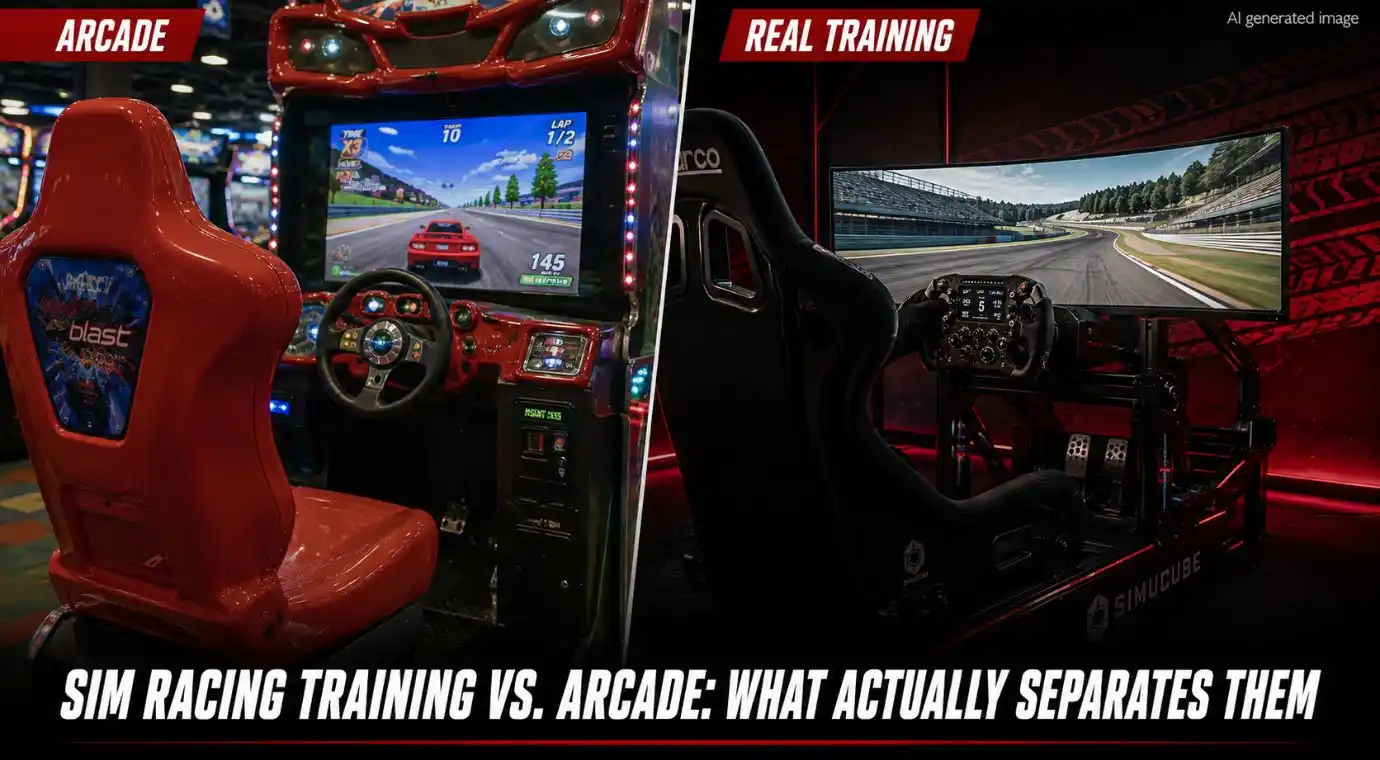
It’s one of the most common assumptions we run into: someone’s tried a racing simulator before, usually a coin-operated machine at a mall or a gaming arcade, and walks away thinking they know what the experience is. It’s an easy assumption to make, and an inaccurate one. A three-minute arcade session and a coached training experience share a steering wheel and a screen, and not much else.
This isn’t a knock on arcade machines. They’re built to do a specific, narrow job well: short, low-commitment fun for a few minutes. But if you’re trying to figure out whether a racing simulator Pune venue is actually worth your time, it helps to understand exactly where the two diverge, because the gap is bigger than most people expect.
The Core Difference: A Ride vs. a Lesson
An arcade racing machine is built around a simple loop, insert coin, drive for a fixed short time, get a score, done. There’s no coaching, no feedback beyond a number on screen, and often very limited realism in how the car responds to input. It’s designed to be immediately fun for anyone, which is exactly why it doesn’t teach anything.
A proper training-focused simulator session is built around a completely different loop: orientation, coached laps, feedback, adjustment, and repetition, the same structure used in actual driver development programs, not a shortened-for-fun version of it. The goal isn’t “have three minutes of fun,” it’s “leave having actually improved at something specific.”
What Real Force Feedback Actually Means
Most arcade machines use light, generic resistance on the wheel, enough to feel like “a wheel” without meaningfully communicating what the car is doing. A proper simulator rig uses genuine force feedback: the wheel pushes back with resistance that reflects tyre grip, weight transfer, and how close you are to losing control of the car. This is one of the most immediately noticeable differences for anyone who’s only experienced an arcade unit, the wheel actually tells you something, rather than just spinning along with your input.
The same gap exists with pedals. Arcade units often use simple on/off or lightly-weighted pedals. A genuine simulator setup uses pedals with real resistance and travel, closer to an actual car, which matters because braking technique, modulating pressure rather than stomping, is one of the first things a coach will actually correct.
Coaching Is the Real Differentiator
This is the single biggest gap, and it’s easy to underestimate until you’ve experienced it directly. An arcade machine offers zero instruction. You drive, you get a time or score, and that’s the entire feedback loop. A coached F1 simulator experience Pune venue offers something structurally different: a person watching your braking points, your line through each corner, your consistency across laps, and giving you specific, actionable corrections in real time.
The difference in outcome is significant. Without coaching, most people plateau quickly, they get marginally faster through trial and error, then stop improving because they don’t know what’s actually holding them back. With coaching, improvement tends to be faster and more obvious, because someone is identifying the specific habit costing you time rather than leaving you to guess.
Circuit Accuracy and Car Behaviour
Arcade titles are typically built for accessibility, not accuracy, forgiving physics, simplified circuit layouts, and car behaviour that prioritizes fun over realism. A serious sim racing Kharadi Mundhwa-area setup uses accurate circuit layouts and car physics that reward the same techniques real drivers use: correct racing lines, proper braking points, and realistic weight transfer through corners. This matters if the goal is genuinely learning something transferable, rather than just having a good few minutes.
How to Tell the Difference Before You Book
A few practical questions to ask, if you’re comparing options:
- Is there a coach or instructor involved, or is it self-directed? Self-directed sessions on an accurate rig can still be worthwhile, but coached sessions are where the real skill development happens.
- How long is a session, realistically? A three-minute arcade cycle and a properly structured 20-30 minute coached block are fundamentally different products, even if both are technically called “racing simulators.”
- Does the venue talk about training, technique, or improvement, or just about fun and thrills? The framing usually tells you a lot about what’s actually on offer.
- Is progress tracked across visits? A training-focused venue typically has some way of showing you improved lap times or coaching notes over time. An arcade machine has no concept of “last time.”
Why This Distinction Matters for Beginners Especially
It’s tempting to assume coaching and structure matter more for experienced sim racers chasing serious lap times, and less for a first-timer just trying it out. In practice, it’s arguably the opposite. A first-timer without coaching often walks away without understanding what they did wrong, or worse, reinforces bad habits (harsh braking, poor lines) simply because nothing corrected them. A coached first session builds the right habits from the very first lap, which makes every session after that more productive.
Frequently Asked Questions
Is a racing simulator the same thing as an arcade racing machine?
No. Arcade machines are built for short, low-skill fun with minimal feedback. A proper training-focused simulator uses accurate force feedback, realistic circuit physics, and coached instruction.
Does force feedback actually matter, or is it just a gimmick?
It matters significantly, genuine force feedback communicates grip levels and weight transfer, which is essential for learning real racing technique rather than just reacting to a screen.
Do I need coaching if I’ve played racing video games before?
Coaching still adds significant value even for experienced gamers, since force-feedback rigs and real coaching correct habits and technique that a standard console setup never addresses.
How can I tell if a venue is training-focused rather than arcade-style before booking?
Ask whether sessions include a coach, how long a session actually runs, whether progress is tracked across visits, and whether the venue emphasizes technique and improvement rather than just short-term fun.
Is a coached session worth it for a complete beginner, or only for experienced racers?
It’s arguably more valuable for beginners, since coaching builds correct habits from the first lap rather than letting bad technique go uncorrected.