
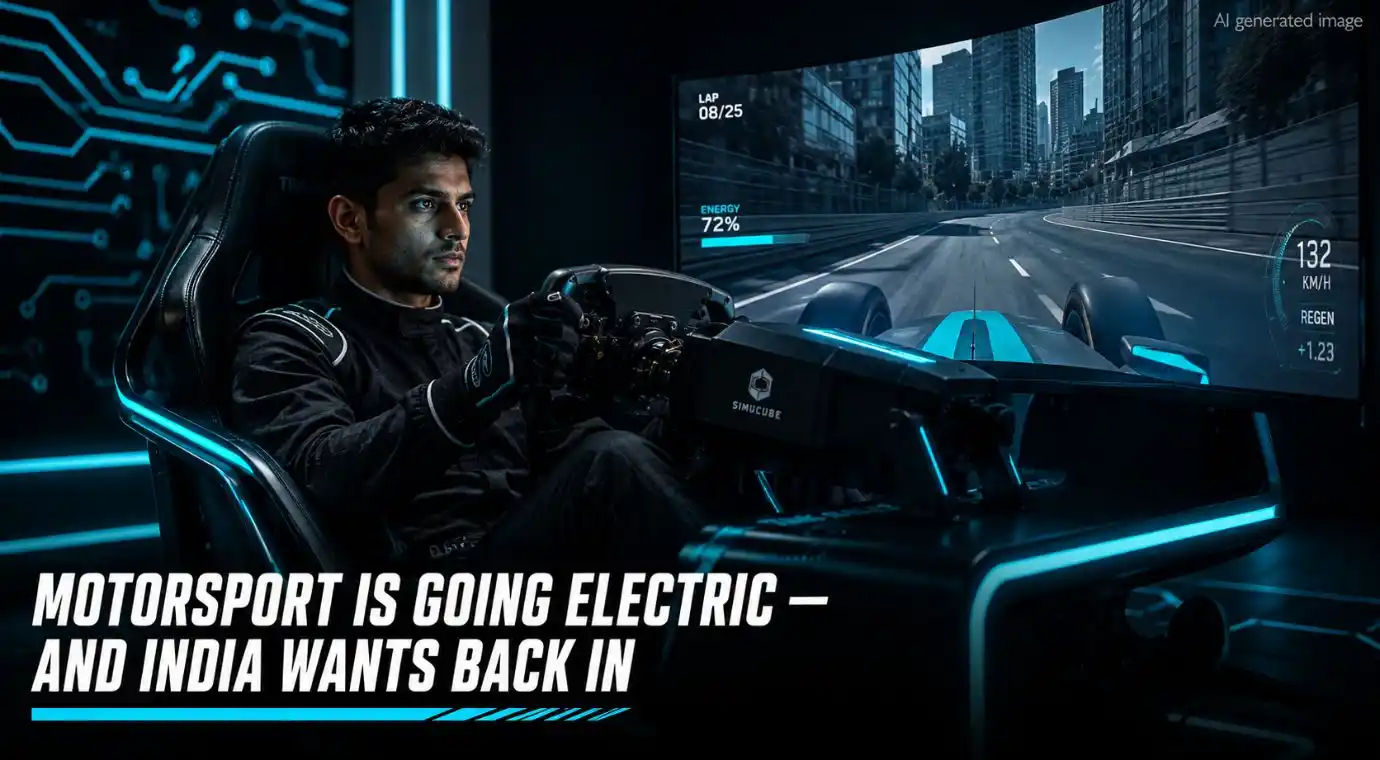
While most of the racing conversation in India right now centres on Formula 1’s new hybrid-heavy 2026 regulations, a quieter but equally significant shift is happening one level over: Formula E, the FIA’s all-electric world championship, is about to enter its biggest technical leap yet. The new Gen4 car, debuting in the 2026/27 season, will be the largest, heaviest, and most powerful car in the series’ history, delivering up to 600kW (roughly 804bhp) of power, a huge jump from the previous generation’s 470bhp ceiling, with all-wheel drive now active throughout the entire race rather than just in short bursts.
For a country that’s building an EV culture from the ground up, this matters more than it might first appear. Formula E has publicly said it wants to return to India, having previously hosted the Hyderabad E-Prix in 2023 before the race was dropped the following year. Series officials have specifically pointed to India’s rapidly expanding EV ecosystem as one of the most attractive markets in the sport’s future plans. Whether or not a race actually returns, the direction is clear: electric racing isn’t a niche experiment anymore, it’s becoming a mainstream pillar of global motorsport, and India is very much part of that conversation.
Why This Matters Even If You Only Follow F1
If your motorsport interest starts and ends with Formula 1, it’s worth paying attention to this anyway, because the two are converging faster than most casual fans realise. F1’s own 2026 regulations pushed the sport toward a 50:50 split between combustion and electrical power, the biggest hybrid shift in the sport’s history. That’s not a coincidence. Electrification is the direction the entire top tier of motorsport is moving, from F1’s hybrid power units to Formula E’s fully electric powertrains. Understanding one increasingly means understanding the other.
This shows up in subtle but real ways behind the wheel too. Electric and hybrid powertrains deliver power differently than a traditional internal combustion engine, instant torque, different energy management considerations, and in Formula E’s case, strategic energy deployment that’s arguably as important to race strategy as tyre management is in F1. Drivers managing an electric powertrain are constantly balancing aggression against energy conservation in a way that rewards a very specific kind of discipline.
What This Means for Sim Racing in Pune
A racing simulator Pune venue built around proper coaching, rather than arcade-style quarter-laps, is well positioned to reflect exactly this shift. Modern sim rigs and racing titles increasingly model energy deployment, regenerative braking, and hybrid power delivery with real accuracy, meaning the fundamentals you’d learn in a coached session (throttle discipline, understanding how a car’s power delivery actually behaves, managing a resource across a stint) map onto both combustion and electric racing more closely than people expect.
For visitors curious about an F1 simulator experience Pune venue offers, this is genuinely useful context: a lot of what makes modern F1 racing tactically interesting, energy deployment, hybrid power management, when to push and when to conserve — has direct parallels in how Formula E is run, and both are increasingly reflected in how simulators model car behaviour.
India’s EV Momentum Goes Beyond the Racetrack
It’s worth zooming out here. India’s EV adoption has been accelerating for years now, well beyond what’s happening in top-tier motorsport, two-wheelers, city cars, and increasingly commercial fleets are shifting toward electric power across the country. Formula E officials have specifically credited this broader cultural shift as part of what makes India an attractive market for the sport’s return, describing the country as one that’s been “building an EV culture” for the better part of a decade.
Pune, as one of India’s major automotive and IT hubs, sits right in the middle of that shift, a city with both a strong engineering talent base and a growing appetite for anything that blends technology with performance. A sim racing Kharadi Mundhwa-area venue that treats simulator training seriously, rather than as a novelty, fits naturally into a city that’s already comfortable with this kind of technical curiosity.
A Different Kind of Team Outing Angle
For companies in Pune’s IT sector, particularly any with EV, automotive, sustainability, or engineering-adjacent work, a sim racing session doubles as a genuinely relevant corporate team outing Pune IT park option, with an easy narrative hook: motorsport’s own shift toward electrification mirrors exactly the kind of technical shift many of these teams work on daily. It’s a rare team outing format that’s actually thematically on-brand rather than just “an activity we did once.”
Curious how energy management and power delivery actually feel from behind the wheel? Book a coached session and find out how much of what you’re seeing in this year’s F1 and Formula E storylines translates to your own driving.
Frequently Asked Questions
What is Formula E?
Formula E is the FIA’s all-electric world championship for open-wheel racing cars, established as a full world championship since the 2019-20 season.
Is Formula E coming back to India?
Formula E previously raced in Hyderabad in 2023 before the event was dropped in 2024. Series officials have publicly said they’d like to return, citing India’s growing EV ecosystem, though no confirmed race date currently exists.
How is F1’s 2026 hybrid system related to Formula E?
Both reflect motorsport’s broader shift toward electrification, F1’s 2026 regulations introduced a 50:50 split between combustion and electric power, while Formula E is fully electric, with both requiring similar energy-management skill from drivers.
Do racing simulators model electric or hybrid power delivery accurately?
Modern sim rigs and racing titles increasingly model energy deployment and regenerative braking with meaningful accuracy, making coached sessions relevant to understanding both traditional and electrified racing.
Is this relevant if I only follow F1, not Formula E?
Yes, the two are converging technically, and understanding energy management concepts from one increasingly helps make sense of the other.