
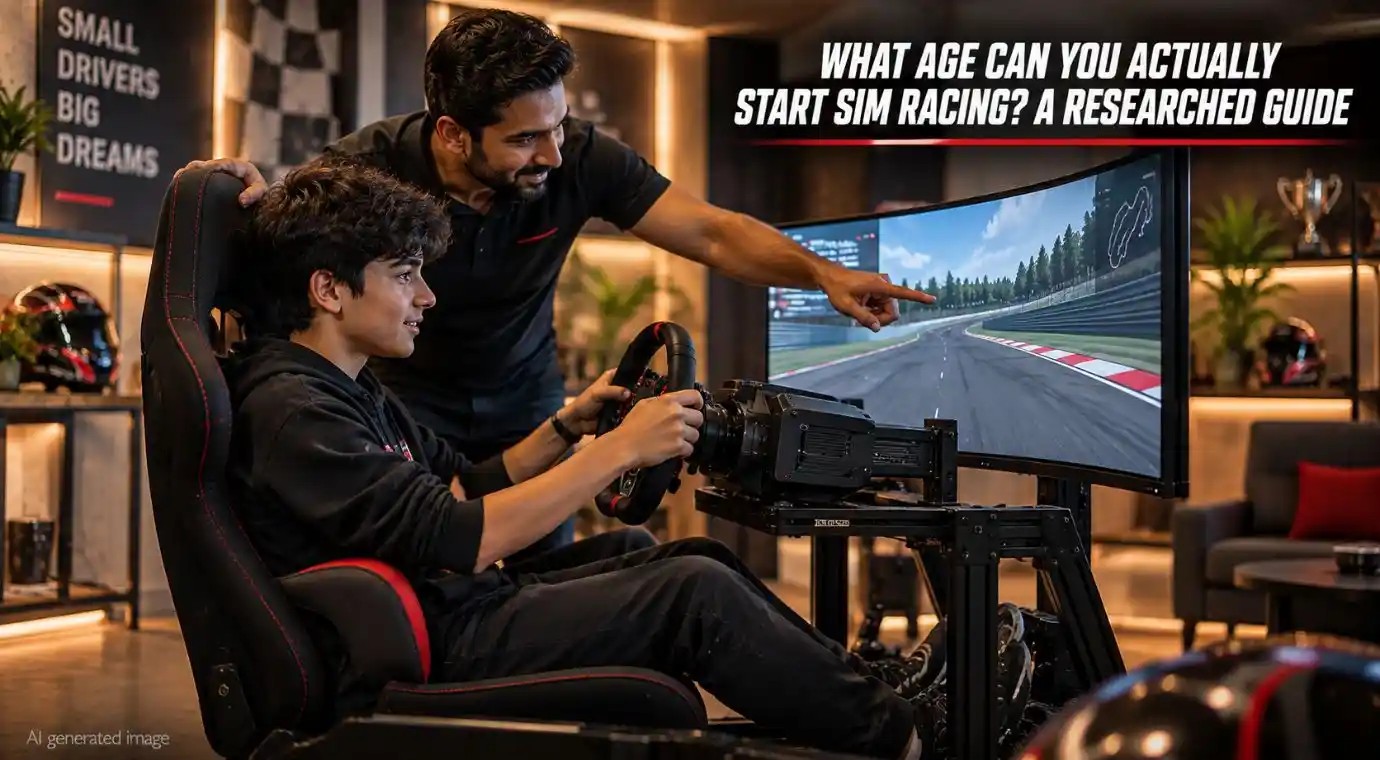
Parents and teenagers curious about motorsport often run into the same wall early on: real racing has real, often strict age barriers. Sim racing generally doesn’t, and understanding exactly why is useful both for deciding when to start and for setting realistic expectations about what’s actually appropriate at different ages.
Real Racing Has Genuine, Regulated Age Barriers
It’s worth understanding the real-world baseline first, because it puts simulator access into proper context. In India, the Federation of Motor Sports Clubs of India (FMSCI), the governing body for national-level motorsport, sets the minimum age for a racing license at 13 years old. Real go-karting venues typically layer additional restrictions on top of this: many indoor karting centres allow children as young as 8 on junior karts, but reserve faster “adult” or “pro” karts for older teenagers who meet both age and height requirements, commonly around 4’10” (147cm), since a driver needs to physically reach and safely operate the pedals and controls.
These aren’t arbitrary rules. They reflect genuine safety considerations tied to physical development, reach, reaction time, and the physical strength needed to control a vehicle at speed. A 9-year-old simply isn’t going to safely operate a full-power adult kart, regardless of enthusiasm.
Why Simulators Remove Most of This Barrier
A racing simulator has none of the physical risk that drives these real-world restrictions. There’s no real vehicle to lose control of, no real speed, no real consequence if a corner goes wrong. This is exactly why simulator venues internationally tend to set dramatically lower age minimums than real karting or racing, F1 Arcade, one of the most prominent simulator venue chains globally, welcomes guests from as young as 7 years old, with additional supervision requirements (an accompanying adult) for children under 14.
This gap, a real racing license requiring a minimum age of 13, versus simulator venues welcoming children from 7, reflects a genuinely important distinction: the physical risk that regulates real racing simply isn’t present in a simulator environment, which is precisely why the entry point is so much earlier.
What Actually Matters More Than a Strict Age Number
Rather than a single hard cutoff, what matters more for simulator readiness is a combination of factors:
- Physical fit with the equipment. Being able to comfortably reach the pedals and see the display properly matters more than a specific birthday.
- Attention span for coached instruction. A structured, coached session involves following instructions and processing feedback, younger children with shorter attention spans may get more out of a shorter session format.
- Genuine interest versus a parent’s interest. Sessions tend to go better, at any age, when the child is actually curious rather than just going along with a parent’s enthusiasm.
Why Starting Younger on a Simulator Genuinely Makes Sense
For a family genuinely interested in a future in motorsport, whether that’s karting, circuit racing, or just serious sim racing as a hobby, starting on a simulator well before the minimum age for real karting or an FMSCI racing license offers a real head start. The fundamentals that transfer from simulator training to real racing, racing lines, braking points, smoothness, situational awareness, are exactly the same regardless of age, and building them early, in a completely risk-free environment, means a teenager arriving at the minimum age for real karting or a racing license already has a meaningful technical foundation rather than starting from zero.
This is directly connected to why a structured, coached sim racing for beginners Pune program is worth considering well before a teenager is old enough for real track time, the skill-building doesn’t need to wait for the age barrier that real racing requires.
What to Expect for Teenage and Younger Sessions
A properly run coached session for a younger or teenage driver typically looks a little different from an adult session:
- Shorter, more focused session blocks rather than long, unstructured practice time.
- More frequent, simpler feedback rather than dense technical corrections all at once.
- Encouragement-forward coaching, building confidence and enjoyment alongside technique, particularly for a first-time young driver.
The Honest Bottom Line
Real racing has genuine, safety-driven age barriers that exist for good reason and shouldn’t be treated as arbitrary red tape. Simulator training doesn’t carry the same physical risk, which is exactly why it can, and often should, start well before those real-world minimums, provided the session is genuinely coached and age-appropriate rather than just handing a child a wheel and walking away.
Curious whether sim racing is a good fit for your child or teenager? Get in touch to discuss age-appropriate session options.
Frequently Asked Questions
What is the minimum age for a real racing license in India?
The Federation of Motor Sports Clubs of India (FMSCI) sets the minimum age for a racing license at 13 years old.
Do simulator venues have the same age restrictions as real karting?
No, since simulators carry no physical driving risk, venues typically allow much younger participants. International simulator venues like F1 Arcade welcome guests from age 7, with supervision requirements for younger children.
What height is typically required for real go-karting?
Many venues require a minimum height of around 4’10” (147cm) for standard adult karts, to ensure a driver can safely reach the pedals and controls, though junior karts are often available for younger, shorter children.
Is it worth starting sim racing before a child is old enough for real karting or racing?
Yes, the fundamental skills (racing lines, braking points, smoothness) transfer directly to real racing later, so an early start on a simulator can build a genuine head start with no physical risk involved.
What’s different about a coached session for a younger driver compared to an adult?
Sessions are typically shorter and more focused, with simpler, more frequent feedback and a stronger emphasis on encouragement and enjoyment alongside technique.