
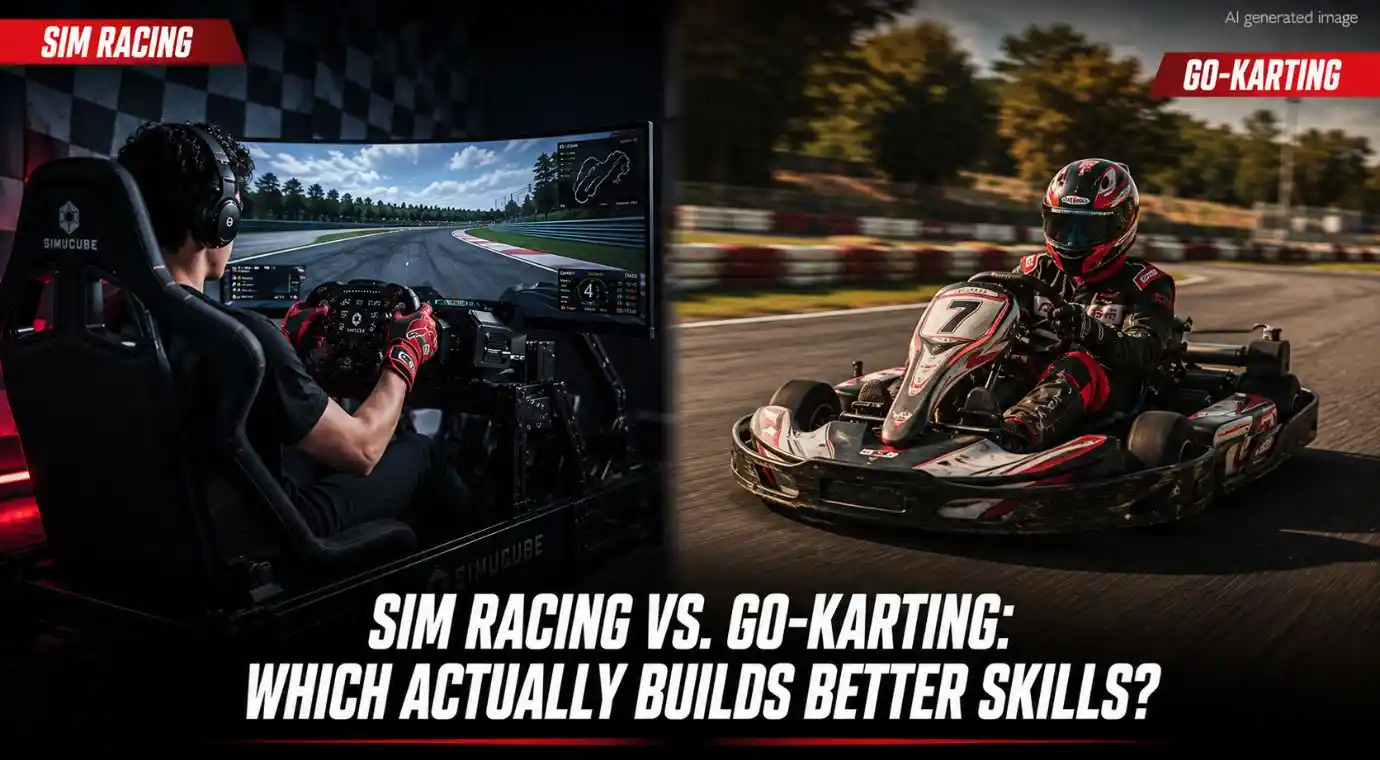
It’s one of the most common questions for anyone starting out in motorsport, and it deserves a properly researched answer rather than a marketing-driven one. Both disciplines build genuine racing skill, but they build different parts of it, in different ways, at very different costs. Here’s an honest, evidence-based comparison.
What the Research Actually Shows
A 2017 study published in PLOS One used eye-tracking technology to compare racing drivers against non-racing drivers in a simulator environment. The findings are genuinely instructive: experienced racing drivers demonstrated faster lap times, more optimal racing lines, and notably different visual scanning behaviour, actively shifting their gaze and head position through corners rather than fixating on a fixed point ahead, the pattern typically seen in non-racing drivers. Interestingly, the study found no significant difference between the two groups in basic reaction time or tracking-task performance, suggesting the real skill gap lies in learned technique and visual strategy, not raw reflexes.
This matters for the sim-vs-karting question specifically, because it points to what’s actually trainable: racing lines, visual scanning technique, and car control are learned skills, refined through repetition and feedback, exactly what both simulators and karts can provide, just through different mechanisms.
What Karting Does Better
Karting’s core advantage is physical authenticity. Real g-forces, genuine mechanical risk, and unfiltered consequences for mistakes create a learning environment no simulator fully replicates. According to motorsport publication NASA Speed News, which interviewed both karting and sim-racing specialists on driver development, karts teach a physical, instinctive relationship with car control that comes specifically from managing real inertia and real risk, something that’s much harder to internalize purely on screen.
Karting also builds real racecraft in genuine wheel-to-wheel competition, reading another driver’s intentions, defending a position under real pressure, and racing in changing, unpredictable track conditions in a way that’s difficult to fully script into simulator training.
What Sim Racing Does Better
Sim racing’s core advantage is repetition without cost or risk. According to Fanatec’s comparison of the two disciplines, sim racing removes travel time, weather interruptions, and mechanical wear from the equation entirely, meaning a driver can focus purely on refining technique with immediate, continuous repetition. This is a genuinely significant advantage for building consistency specifically, the ability to repeat a clean lap rather than produce one good lap through luck.
It’s also worth noting how seriously top-level motorsport now takes sim training. Max Verstappen has spoken publicly about the value of simulation training as part of a driver’s development, reflecting how seriously elite drivers now treat simulators as a genuine training tool rather than a toy, a shift that’s changed how the motorsport industry views the sim-to-real pathway over the last several years.
The Cost Difference Is Larger Than Most People Expect
Cost is one of the most practically significant differences between the two, and it’s worth being specific about why. A structured, coached sim racing program typically delivers meaningfully more actual training time, with telemetry feedback and repeated attempts at the same corner, for a comparable or lower total cost than the equivalent hours of go-kart track time, once fuel, tyre wear, and mechanical costs are factored in. This isn’t a knock on karting’s value, it’s a genuine difference in what each hour of spend actually buys in terms of structured training time.
A Side-by-Side Comparison
| Factor | Sim Racing | Go-Karting |
|---|---|---|
| Physical risk | None | Real, though managed with safety gear |
| Weather dependency | None, fully indoor | Fully dependent on outdoor conditions |
| Cost per training hour | Generally lower | Generally higher (fuel, tyres, maintenance) |
| Repetition speed | Immediate, no downtime | Limited by track time, fuel stops, fatigue |
| Physical g-force feedback | Limited, even on advanced rigs | Full, authentic |
| Wheel-to-wheel racecraft | Simulated, improving but limited | Genuine, real-time |
| Consistency-building | Strong, no fatigue or wear factors | Harder to isolate from physical fatigue |
| Best for | Technique, racing lines, consistency | Instinct, real risk judgment, racecraft |
So Which Should You Actually Try First?
Based on the research and expert commentary above, the honest answer is that they’re not really competing for the same job. For someone starting completely from zero, a coached racing simulator Pune session is the lower-risk, lower-cost way to build the technical foundation, racing lines, braking points, consistency, before ever needing to manage the real physical and financial stakes of karting. For someone who’s already karting and wants to refine specific technique without burning real track time and tyres doing it, simulator sessions are a genuinely effective supplement, not a replacement.
This is precisely the reasoning behind treating simulator training as the first stage of a genuine path toward real karting, rather than a competing alternative to it — building the fundamentals where mistakes are free, then applying them where the stakes are real.
Curious to build your own foundation before deciding which direction to take it? Book a coached session and start with the fundamentals that transfer either way.
Frequently Asked Questions
Is sim racing a good substitute for go-karting?
Not entirely, sim racing builds technique, consistency, and racing lines effectively, but it can’t fully replicate the physical g-forces, real risk, and wheel-to-wheel racecraft that karting develops.
Do professional racing drivers actually use simulators for training?
Yes. Top-level drivers, including current F1 champions, have spoken publicly about incorporating serious simulator training into their preparation, reflecting how seriously the sport now treats sim racing as a genuine development tool.
Is sim racing cheaper than go-karting?
Generally yes, particularly per hour of structured training time, sim racing avoids fuel, tyre wear, and mechanical maintenance costs that add up quickly with real karting.
What does research say about the skill difference between racing and non-racing drivers?
A 2017 PLOS One study found experienced racing drivers showed faster lap times, more efficient racing lines, and different visual scanning patterns compared to non-racing drivers, with no significant difference in basic reaction time, suggesting the real skill gap is in learned technique, not raw reflexes.
Should a complete beginner start with sim racing or karting?
Starting with coached sim racing is generally lower-risk and lower-cost for building foundational technique, which can then transfer into real karting once the fundamentals are solid.